Keeping a tidy lawn usually means dragging out the mower. But sometimes that just isn’t an option. Maybe the mower gave up at the worst moment. Maybe there isn’t one in the shed at all. Or maybe the garden is so small and awkward that a full-size machine feels like overkill.
The good news? You can learn how to cut grass without a lawn mower. In fact, it can save money, reduce noise, and cut down on fuel use too.
With a few simple tools, and a bit of patience, you can keep your grass under control and nobody would know you didn’t use a mower.
Table of Contents
What can you use to cut grass by hand?
You can cut the grass with some simple gear. It all comes down to the size of the area and how tidy you want the finish. Let’s look at some options.
Grass shears (manual lawn scissors)
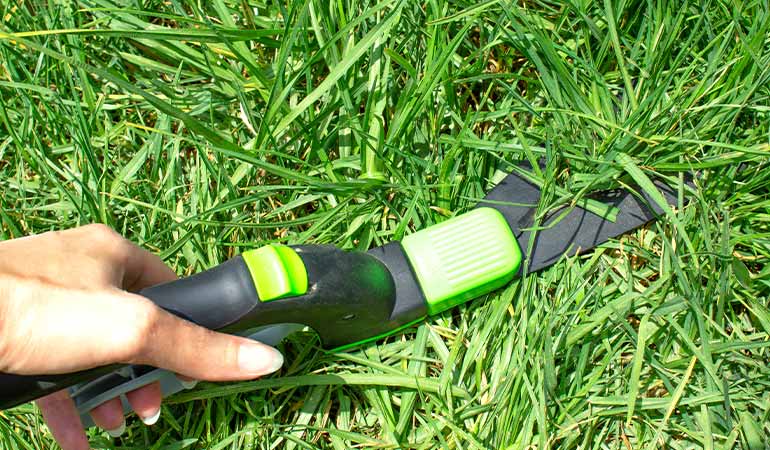
Grass shears are like scissors, but bigger and made for grass. They have long, sharp blades and short handles that give you good control. You open and close them by hand to snip the grass exactly where you want it. It doesn’t get simpler than that. For that reason, grass shears are ideal for detail work rather than full lawn cuts or speed.
You can find two types on the market:
- Handheld shears – short handles, used while kneeling or bending. Best for tight spots.
- Long-handled shears – extended handles so you can work standing up. Easier on your back.
Since grass shears work much like their regular counterparts, some of you might ask, “Can you use scissors to cut grass?” The answer is yes if you only need to tidy a tiny patch. For anything larger, your hands will regret the decision.
Strimmer / Grass trimmer
One of the most practical mower alternatives. Instead of metal blades, it uses a fast-spinning nylon line that slices through grass on contact.
The tool runs at high speed while you sweep it side to side just above the ground. To be honest, it clears grass surprisingly quickly. This leads many people to ask if you can mow a lawn with a strimmer and not even get a mower. The short answer is yes. It can handle a full lawn if needed, especially smaller or awkward gardens. The trade-off is that the finish usually looks less even than that of a traditional mower.
When you compare grass trimmer vs lawn mower, the difference comes down to purpose, really. A mower gives a fast, level cut across open lawns. A grass trimmer offers flexibility and can handle uneven ground, slopes, and tight access areas where mowers struggle.
On the market you will find several types of strimmers:
- Corded electric models are lightweight and budget-friendly but limited by cable reach.
- Battery-powered trimmers offer more freedom and suit most home gardens.
- Petrol versions deliver the most power and tend to suit thicker growth or larger spaces.
Scythes
The old-school grass cutter. It features a long, curved blade mounted on a wooden handle. Armed with this tool, you cut grass with a sweeping motion. Despite its antique look, a scythe still works extremely well in the right setting, that being rural properties or large plots where neat stripes are not the priority.
To use a scythe, develop a smooth technique. Move the blade in a shallow arc just above the soil in steady rows. When this rhythm clicks, the tool cuts efficiently and with less effort than most people expect.
Blade care makes a huge difference, too. With a sharp edge, you feel the scythe moving cleanly through grass, while a dull one turns the job into hard labour.
There is something to be said about safety, too. Wear sturdy shoes and gloves to protect yourself, and keep the working area clear while you swing.
Sickle
Another tool you can use instead of a lawn mower. A sickle is a short, curved hand tool with a sharp inner blade. You hold the handle in one hand and pull the blade toward you in a controlled slicing motion. That’s it.
You can use it to clear rough tufts of grass, tidy neglected corners, or manage growth around beds and fences. It is not the fastest option, but it gives you solid control in tight spots.
As with the scythe, technique here also matters. You need to do short, steady pulls and not wild swings. Keep the blade close to the ground and work in small sections to avoid missing clumps.
In terms of safety, you need to wear sturdy gloves and closed shoes, and always cut away from your body. Keep your free hand well clear of the cutting path.
Keep the blade sharp and clean after use and this tool will serve you for a lifetime.
Hedge trimmer
A hedge trimmer is built for shaping shrubs, but it also works for grass when the lawnmower is out of the question. It uses two toothed blades that move back and forth at high speed, which slice through plant material as you guide the tool.
If you decide to try this method, use it only on flat, even grass. Hold the trimmer level and move it slowly across the surface. It can knock down grass quickly, but it does not naturally produce the neat, level finish that a mower gives. It struggles on uneven ground and tends to leave a patchy look if you move too fast or change angles. One slight tilt and you scalp one patch while leaving the next too long. Work slowly and check your progress often.
You do not need special training to use a hedge trimmer, but you do need a steady hand. Also, you might get tired of staying bend over whilst holding this contraption.
How to properly cut grass without a lawn mower
Regardless of which method you choose when you are forced to cut the grass without a lawn mower, you always need to follow the same rules.
Safety first! Wear sturdy gloves to protect your hands from blisters and sharp edges. Put on eye protection, especially when using a strimmer, because, like you already know, small stones and debris can fly up fast.
Choose proper footwear with closed toes and good grip. Flip-flops are not an option, so don’t even consider them. Ever.
Last but not least, take regular breaks, not when you get tired, but so as not to get tired. Fatigue leads to sloppy cuts and poor control.
Prepare the area
Walk the area first. Look for stones, sticks, and loose debris and remove each piece you find. Any hard object can damage your tools or become a dangerous projectile. Look carefully for hidden items like toys, wire, or garden ornaments buried in the grass. Remove those too.
Another thing you should consider as preparation to cut grass without a mower is to wait for the grass to dry. Here is the reason: damp grass clumps together, clogs tools, and tears. You might think it cuts clean when wet, but it’s the opposite.
In the UK try to cut on a dry day in the late morning or early evening. The grass shouldn’t be strained by the severe noon heat, but it should feel dry to the touch. The grass should always be dry, regardless of the tool you employ.
Get familiar with the tool you are going to use
Learn how to use whatever it is that you plan to use. Then the best results will come from matching the right tool with the right job.
For small patches or fiddly edges, grass shears are your best friend. They give you proper control where precision matters. Use short, steady snips and move slowly along the edge. It’s not fast, but at least it leaves things looking neat.
For a medium lawn or uneven ground, you need a strimmer. Sweep it side to side in smooth, relaxed passes and keep the line just above the soil. Work in rows so you don’t leave random stripes behind. It’s much quicker than hand tools, but don’t rush it. You might get a patchy finish that will annoy you later.
And when the grass has become a jungle, bring out the scythe. This tool handles long, thick growth far better than anything small and handheld. Use the smooth, gliding swing and move forward bit by bit.
For rough little corners where shears feel too weak but a scythe feels like too much, use a sickle. It’s perfect for stubborn clumps and neglected edges.
Remember things like this:
- Small patch – shears
- Medium lawn – strimmer
- Tall or overgrown grass – scythe
- Rough small areas – sickle
Cut in sections
If you try to tackle the whole lawn at once, you will end up in frustration. Break the area into manageable sections and work through them one at a time.
Move in steady rows so you can clearly see what you have already cut. This helps keep the finish and stops you from missing strips of grass.
Try to keep the cutting height consistent as you work. If you constantly change height, the lawn ends up looking patchy. Avoid cutting too short, especially in warm or dry weather. Taking off too much at once stresses the grass and slows recovery.
Collect and dispose of the grass clippings
Once the cutting ends, dispose of the clippings before they smother the lawn. Here is one lawn care tip – if the clippings are light and fine, you can leave a thin layer on the lawn as mulch. This helps return moisture and nutrients back into the soil.
On the other hand, the thicker piles should go to a compost bin where they will break down into useful garden material.
There is also another way to cut your grass. It’s called professional lawn mowing
Enter your postcode to view our rates and availability in your area.
For questions about the services we offer visit our main site
Is it a good idea to cut grass manually?
The short answer is yes, but it depends. Cutting grass manually without a lawn mower can work well, for small or awkward gardens, but it’s not for everyone.
If your lawn is small, irregularly shaped, or the mower is broken, hand tools let you keep the grass under control without spending money on repairs or new equipment. It also works if you want to save on fuel or electricity, reduce noise, or lower your environmental footprint. Manual methods can even be handy during power outages or in areas with strict noise restrictions.
However, manual cutting takes more time than a mower, especially on medium and large lawns. You’ll use more physical effort too. The end result might not be as uniform as a machine cut, so don’t expect perfect stripes.
Takeaways
- You can keep your lawn tidy even if you don’t have a mower at the moment.
- You should always pick the best grass cutting tool according to the size of your lawn.
- Safety matters too so wear gloves, eye protection, and proper footwear, and always clear debris first.
- Always cut dry grass and work in sections to avoid a patchy, uneven lawn.
- Manual cutting saves money and reduces noise, but it takes more time and physical effort than using a mower.
- The truth is, no other tool will make your lawn as even as a mower, but that doesn’t mean they’re not good.