You step outside on a damp autumn morning, coffee in hand, and there they are. A cluster of mushrooms poking up through your lawn like they own the place. It’s the kind of thing that makes you do a double-take. Where did they come from? Are they harmful? And more to the point, how do you get rid of mushrooms in your lawn without making things worse? If this sounds familiar, you’re in good company.
The slightly surprising truth is that mushrooms aren’t always bad news. In fact, they’re often a sign that something interesting is going on beneath the surface. But we get it — most people just want a clean, tidy lawn. So let’s look at what’s actually causing them, what you can do about it, and how to keep them from coming back.
TL;DR
- Mushrooms in lawns usually signal healthy soil with lots of organic matter breaking down underground.
- Removing visible mushrooms by hand or rake before they open stops spore spread, but won’t eliminate the fungal network below.
- Natural treatments like diluted vinegar and baking soda can suppress mushroom regrowth in affected patches.
- Improving drainage and aerating your lawn regularly are the most effective long-term deterrents.
- Buried organic matter — old roots, stumps, woody debris — is often the underlying cause worth addressing directly.
- Regular mowing, raking, and good lawn hygiene prevent the damp conditions mushrooms love.
- Mushrooms play a useful role in decomposition, so the goal is management rather than total elimination.
Table of Contents
Why Do Mushrooms Grow in Lawns?
Mushrooms grow in lawns when the conditions underground suit fungal activity — mainly decomposing organic matter, consistent moisture, and shaded or compacted soil. They’re the fruiting body of fungi living beneath the surface, feeding on buried wood, old roots, or decaying grass. In most cases, their presence is a sign of a biologically active, healthy soil.
Think about what’s often buried beneath a typical UK lawn. Old tree stumps, leftover roots from shrubs removed years ago, thatch build-up, even old timber from a long-forgotten raised bed. Fungi love this stuff. They break it down slowly over time, and occasionally, when conditions are just right, they push mushrooms up above ground to spread their spores.
Damp weather is a big trigger, which is why you tend to see flushes of mushrooms in autumn and after heavy summer rain. Shaded areas that don’t dry out quickly are especially prone. Compacted soil that holds moisture rather than draining it away gives fungi exactly the environment they thrive in.
It’s also worth knowing that some mushrooms form what’s called a fairy ring — a circle of grass that’s often darker green or patchy in places. This is caused by fungi spreading outward from a central point underground. It’s not dangerous to your lawn in the early stages, but the circle tends to expand each year if nothing is done about it, and in more advanced cases it can start to affect the grass inside the ring.
How to Get Rid of Mushrooms in Your Lawn
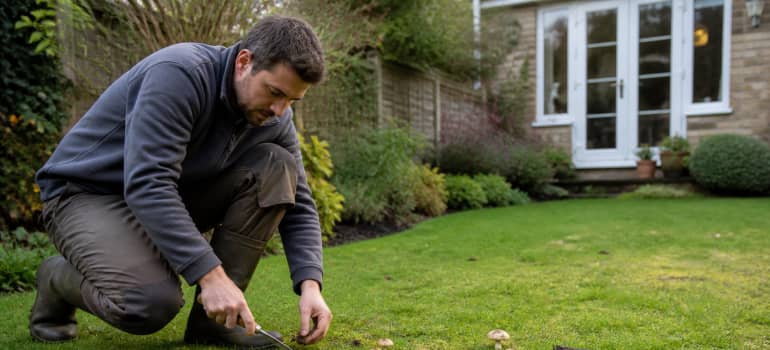
To get rid of mushrooms in your lawn, remove them by hand or rake before they release spores, dispose of them in a sealed bag, and treat the affected soil with a natural solution like diluted vinegar or baking soda. This won’t kill the underground fungal network immediately, but it disrupts growth above the surface and slows regrowth significantly.
Here’s a straightforward checklist to work through when you spot mushrooms appearing:
- Remove visible mushrooms by hand or with a rake before they fully open — once caps open, spores spread fast
- Place removed mushrooms directly into a sealed plastic bag — don’t leave them on the lawn or add them to your compost heap
- Apply a natural vinegar or baking soda solution to the affected area to discourage regrowth
- Rake out any thatch or debris around the area to remove potential food sources
- Aerate the soil around the patch to reduce moisture retention
- Check for buried organic matter underneath — if there’s an old root or stump below, removing it will make a real difference long-term
Be realistic about what this approach achieves. Picking mushrooms off and treating the surface does help, especially if you’re consistent. But the fungal mycelium — the network of thread-like roots beneath the soil — can be extensive. You might remove the visible mushrooms today and see new ones appear next week. That’s not a failure. It just means the underlying cause is still there.
The honest truth is that surface treatments manage the symptom. Addressing the soil conditions and removing buried organic matter tackles the cause. Both have their place, and doing them together gives you the best result.
What Are the Best Natural Methods for Mushroom Control?
The two most effective natural methods for controlling mushrooms in a lawn are a diluted white vinegar spray and a baking soda solution. Both disrupt the surface soil conditions fungi need to fruit. Neither eliminates the underground network, but used consistently, they reduce how often mushrooms reappear.
Not a fan of reaching for chemicals? Good. These two options are cheap, straightforward, and completely safe for children, pets, and the rest of your garden.
Vinegar Solution
White vinegar works by making the soil temporarily more acidic, which disrupts fungal activity near the surface. Mix three parts white vinegar with one part water in a garden sprayer. Apply it directly to the mushrooms and the surrounding soil on a dry day — ideally when no rain is expected for a few hours so it has time to soak in properly.
Spray in the morning if you can. You’ll often see the mushrooms wilt and die back within a day or two. Reapply every week or so if new growth appears. One word of caution: vinegar can affect the grass around the treated area if you drench it heavily. Keep the spray targeted on the mushroom patches rather than sweeping it broadly across the lawn.
Baking Soda Treatment
Baking soda works slightly differently. It raises the pH of the soil surface, making conditions less comfortable for fungi. It’s a gentler option and less likely to affect the surrounding grass.
Dissolve two tablespoons of baking soda in a litre of warm water and stir until fully dissolved. Pour or spray it directly onto the affected area, making sure the soil soaks it up rather than just dampening the surface. Do this every few days during an active flush of mushrooms, then drop to once a week as a preventative measure once things calm down.
Neither of these is a silver bullet, and it’s worth being honest about that. If there’s a large chunk of buried timber feeding the fungi two feet underground, no amount of baking soda is going to sort that. But as part of a broader approach, both methods are genuinely useful.
How Can You Prevent Mushrooms Coming Back?
The most reliable way to prevent mushrooms returning is to remove the conditions they depend on — buried organic matter, compacted soil, and poor drainage. Consistent lawn maintenance across the year does most of the work.
Once you’ve dealt with the immediate problem, the next step is making your lawn less hospitable to mushrooms going forward. This isn’t complicated, but it does take a bit of consistent effort. The good news is that everything you do here also benefits the overall health and look of your grass.
- Aerate regularly — Compacted soil holds moisture and creates the perfect damp environment for fungal growth. Aerating your lawn in spring or autumn, either with a garden fork or a hollow-tine aerator, opens up the soil, improves drainage, and lets air circulate. Even a basic fork will do the job on a small lawn.
- Improve drainage — If your lawn sits in a low-lying area or the soil is heavy clay, water pools rather than drains away. Consider top-dressing with sharp sand after aeration to improve soil structure over time. In more stubborn cases, a simple French drain along the edge of the lawn can make a significant difference.
- Mow at the correct height — Grass that’s cut too short gets stressed and thin, which opens the door for all sorts of lawn problems including fungal activity. Aim to keep grass around 4–5 cm during the growing season. Healthier, fuller grass is simply more resilient.
- Rake up autumn leaves promptly — A thick layer of wet leaves sitting on your lawn is basically a mushroom welcome mat. The same goes for grass clippings left in clumps — scatter them lightly or collect them to stop a damp thatch layer building up.
- Remove buried organic matter — Old stumps, large roots, and buried timber are the most common reason mushrooms keep returning to the same spot. If you can locate and remove the source, you remove the food supply the fungal network depends on.
If you’d rather hand the ongoing upkeep to someone with the right tools and experience, a professional lawn care service takes care of the regular feeding, scarifying, and seasonal treatments that keep your turf in good condition all year round.
Get expert help keeping your lawn healthy all year round
Enter your postcode to view our rates and availability in your area.
For questions about the services we offer visit our main site
Conclusion
Mushrooms in a lawn are rarely a crisis, but they’re definitely worth dealing with properly. Removing them by hand, applying natural treatments like vinegar or baking soda, improving drainage, and aerating regularly will all make a real difference — especially when you tackle them together rather than relying on just one approach. Consistency beats any single dramatic fix every time.
Above all, try to see the mushrooms as part of the picture rather than just a nuisance. When you understand what they’re telling you about your soil, you’re in a much better position to improve your lawn for the long term. A few mushrooms here and there is a small price to pay for genuinely healthy, living soil beneath your feet.