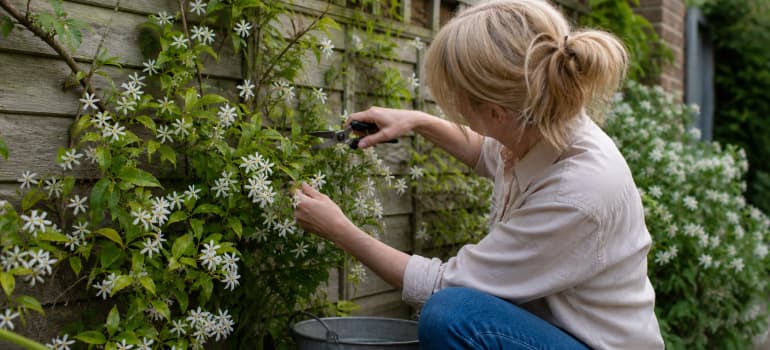
Pruning jasmine is not just about snipping away excess growth. It’s a strategic task that keeps your climbing jasmine healthy, blooming vigorously, and free from the kind of tangled chaos that can take over a fence or wall before you’ve even noticed. Many gardeners, both novice and seasoned, accidentally make mistakes that hurt the plant’s health and its ability to flower well. If you’ve ever stood in front of your jasmine with secateurs in hand and felt slightly unsure, you’re in good company.
This guide will walk you through the most common pruning pitfalls, explain when and how to prune jasmine properly, and cover the differences between the main types you’re likely to find in a UK garden. Get this right, and you’ll be rewarded with dense, fragrant growth year after year.
TL;DR
- Prune jasmine annually to keep it healthy and flowering well.
- The best time to prune jasmine is immediately after it finishes blooming in summer.
- Avoid pruning in late autumn or winter — fresh cuts are vulnerable to frost damage.
- Over-pruning can reduce flowering and stress the plant significantly.
- Always use clean, sharp tools to cut down the risk of spreading disease.
- Summer jasmine and winter jasmine have different pruning schedules — know which you have.
- Overgrown jasmine can be cut back, but do it gradually to avoid shocking the plant.
Table of Contents
How and When to Prune Jasmine
Prune jasmine immediately after it finishes flowering. For summer jasmine (Jasminum officinale), that means late summer, typically around August. This gives the plant the rest of the growing season to produce new shoots that will carry next year’s flowers, without the risk of accidentally removing buds that are already forming.
It makes sense when you think about how jasmine works. The flowers appear on growth that developed during the previous season. Prune in spring and you’re removing those flower-bearing shoots before they’ve done their job. Prune too late in the year and any new growth that follows won’t have time to harden off before the cold arrives.
Late summer is the sweet spot. Here’s how to approach it, step by step.
Start by removing all the deadwood. Work through the plant methodically and cut out any stems that are brown, dry, and clearly no longer alive. This opens up space and makes everything that follows much easier to see.
Next, look at the overall shape. Identify any shoots that have wandered well beyond where you want them, particularly growth heading into gutters, over windows, or tangling with other plants. Cut these back to a healthy sideshoot or a strong bud. You’re not stripping the plant back hard here, just reining it in.
Then thin out congested areas. Where stems are crossing densely and very little light is getting through, remove some of the older stems to improve airflow. Keep the younger, more vigorous growth and remove the older, woodier stems where there’s overcrowding.
Finally, give the whole plant a light tidy. Take off any weak or spindly shoots that aren’t going to amount to much. Step back, assess the shape, and resist the urge to keep cutting just because the secateurs are in your hand.
Does It Matter Which Type of Jasmine You Have?
Yes, it matters a lot. The two types most common in UK gardens have different flowering times, which means they need pruning at different points in the year. Pruning them on the same schedule is one of the most reliable ways to kill off next season’s flowers before they’ve had a chance to form.
| Summer Jasmine (Jasminum officinale) | Winter Jasmine (Jasminum nudiflorum) | |
|---|---|---|
| Flowers July to September | Flowers November to March | |
| Twining climber, needs support | Scrambling shrub, doesn’t self-cling | |
| Prune immediately after flowering, late summer | Prune immediately after flowering, early spring | |
| Moderate pruning — trim flowered shoots, thin congestion | Can be cut back more firmly to a framework | |
| Strongly scented | Unscented | |
| Best on a sunny, sheltered wall or fence | Tolerates a north-facing wall |
Prune winter jasmine in early spring, once the flowers have finished and before new growth gets going. It’s a forgiving plant in terms of how hard you can cut it, but the timing still has to be right.
If you’re not sure which type you have, look at when it flowers. Yellow flowers in winter or early spring with no scent? That’s winter jasmine. White flowers in summer with a beautiful fragrance? That’s summer jasmine. Worth confirming before you reach for the secateurs.
Expert Tips for Pruning Climbing Jasmine
Climbing jasmine needs a bit more thought than a simple border shrub. It’s growing vertically, leaning on structures, and trying to cover ground at the same time as producing flowers. These tips come from managing it well over many seasons.
- Use a wire framework on the wall. Horizontal wires fixed to the wall or fence give you something to tie new growth onto and train the plant deliberately. Without this, jasmine sprawls where it pleases and becomes much harder to manage at pruning time. It also makes it easier to pull sections away from the wall for access when you’re working.
- Train stems horizontally to encourage more flowers. Stems tied in horizontally rather than straight upward tend to produce more flowering sideshoots along their length. It’s a simple trick that noticeably increases flower count without any extra pruning work.
- Don’t let the base become too congested. The lower section of a climbing jasmine often builds up a dense knot of old stems over time. When light and air can’t reach the base, new growth struggles. Every year or two, remove a few of the oldest stems from the bottom of the plant to keep things open.
- Redirect wayward shoots before they become a problem. It’s far easier to tie a new shoot in the direction you want when it’s young and flexible. Left alone, those shoots stiffen and either become impossible to move without snapping or end up tangling somewhere you don’t want them.
- Step back regularly while you work. When you’re close up, it’s easy to over-prune one section and under-prune another. Every few minutes, step back and look at the whole plant. This simple habit keeps the shape even and stops you getting carried away.
- For overgrown plants, spread renovation over two or three years. If your jasmine has really got away from you, resist the temptation to sort it all out in one go. Remove a third of the oldest stems in year one, another third in year two, and so on. The plant stays functional, keeps flowering, and you gradually restore the structure without shocking it.
Common Mistakes to Avoid When Pruning Jasmine
It’s surprisingly easy to go wrong with jasmine pruning, especially because the plant looks so robust. But jasmine has its quirks, and a few bad habits can quietly set it back. Here are the mistakes that come up again and again.
- Pruning at the wrong time. Cutting jasmine at the wrong point in the season is one of the most common errors. Prune too early in the year and you risk removing the buds that would have become this summer’s flowers. Prune in autumn or winter and you leave fresh wounds exposed to frost, which can cause dieback and weaken the whole plant.
- Over-pruning. More is not more when it comes to jasmine. Hacking it back too hard can stress the plant, reduce the energy it has available for flowering, and in some cases stunt growth for a full season. If you’ve ever pruned enthusiastically in spring and then waited all summer for flowers that never came, over-pruning may well be why.
- Using dull or dirty tools. Blunt secateurs crush stems rather than cut them cleanly. That ragged damage is a gateway for fungal disease and bacterial infection. Dirty tools are even worse, because they can carry pathogens directly from one plant to another. It’s a quick fix to sharpen and wipe your tools down, but many gardeners skip it.
- Ignoring the plant’s underlying structure. Jasmine climbs by twining, and over time it builds up a framework of older woody stems. If you just trim the surface without thinning out the old growth beneath, the interior becomes congested. Poor air circulation leads to mildew, and the plant struggles to push strong new growth through the tangle.
- Cutting back into very old, thick wood. Jasmine doesn’t regenerate as reliably from old wood as some other climbers do. Cutting hard into stems that are several years old can leave you with a slow-to-recover or permanently weakened plant. Gradual renovation, rather than a single dramatic cut, is always the safer approach.
- Neglecting to remove deadwood. Dead stems stay dry and brittle inside the plant, taking up space and sometimes harbouring pests. Skipping this step might seem harmless, but it adds to congestion and makes it harder to spot genuine problems early.
Tools and Techniques for Effective Jasmine Pruning
Having the right tools makes a real difference, not just for comfort but for the health of the plant. Here’s what you need before you start.
- Sharp bypass secateurs for stems up to about pencil thickness
- Loppers for thicker, older stems that secateurs can’t handle cleanly
- Gardening gloves to protect your hands from scratches and sap
- A small handsaw for any very thick woody stems at the base
- A disinfectant solution for cleaning tools between cuts
- Twine or soft plant ties for training new growth after pruning
Tool hygiene is genuinely important and regularly skipped. Wipe your blades with a disinfectant solution before you start, and again if you’ve been cutting into diseased or dead tissue. It takes thirty seconds and can prevent you from spreading fungal problems through the whole plant or to others in the garden.
Deadheading
Deadheading jasmine means removing spent flower clusters once they’ve faded. It won’t make the plant rebloom in the same season, but it keeps things looking tidy and stops the plant putting energy into producing seed. Snip off the old flower heads just above a healthy leaf or bud. It’s quick work, worth doing during the flowering season rather than leaving it all until the main annual prune.
Thinning
Thinning is about selectively removing stems to open up the plant’s interior. You’re not reducing the height or spread much — you’re creating space within the plant. Identify stems that are crossing, rubbing, or simply adding to a congested mass in the centre, then remove them at their base or back to a strong junction. Good thinning improves air circulation and lets light reach the newer growth lower down.
Rejuvenation Pruning
Rejuvenation pruning is for jasmine that’s been neglected for several years and has become a woody, impenetrable tangle with flowers only at the very tips. Spread it over two to three years rather than doing it all at once. In year one, identify the oldest, thickest stems and remove a third of them entirely, cutting as close to the base as you can. Let the plant recover through the season. Repeat with another third the following year. By year three, you should have a plant with a much younger, more productive framework and a lot more flowers to show for it.
What to Avoid in the Months Around Pruning
Timing your prune correctly is half the job. The other half is knowing what not to do in the weeks before and after.
In late winter, before growth picks up, check for frost damage on any stems that look blackened or mushy and cut those back to healthy wood. It’s also a good moment to check that your wall fixings and training wires are still secure. Nothing unravels a well-trained jasmine faster than a wire that’s come loose over winter.
In summer, keep an eye on the plant between pruning. Watch for powdery mildew, which shows up as a white coating on the leaves, usually during dry spells when air circulation is poor. The best defence is the thinning you do at pruning time — a well-opened plant is far less prone to it than a congested one.
In autumn, leave jasmine alone. Any pruning now risks stimulating soft new growth that won’t harden before temperatures drop. The plant needs to wind down naturally. Let it.
A professional garden maintenance service takes care of all the regular seasonal attention across your whole garden, which is genuinely useful when there’s a lot to keep on top of through the year.
Get expert help keeping your jasmine and garden looking their best
Enter your postcode to view our rates and availability in your area.
For questions about the services we offer visit our main site
Conclusion
Knowing how to prune jasmine well comes down to timing, restraint, and a bit of understanding about how the plant works. Prune at the right point in the season, keep your tools sharp and clean, and resist the urge to cut back harder than necessary. Do that consistently each year and jasmine is genuinely one of the more rewarding climbers you can grow.
The mistakes in this guide are easy to avoid once you know what to look for. Figure out which type of jasmine you have, prune it at the right time, and let the plant do the rest. A well-maintained jasmine is worth every bit of effort when it’s in full, fragrant flower.