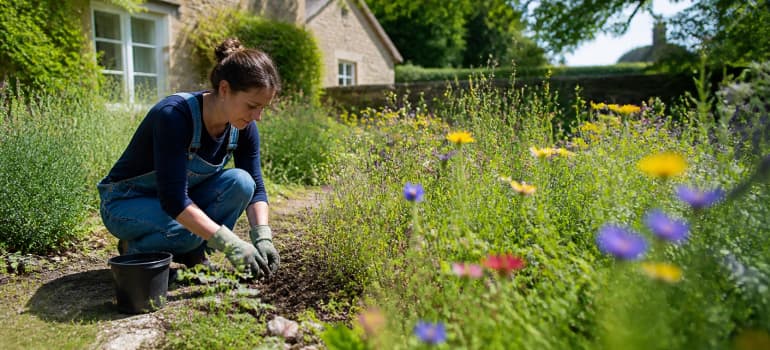
There’s something quietly soul-destroying about spending a Saturday afternoon mowing a lawn that looks exactly the same the following Saturday, demanding to be mowed again. If that sounds familiar, you’re not alone. Millions of UK gardens are dominated by grass that takes constant effort, provides almost nothing for wildlife, and honestly, isn’t all that beautiful. But there’s a genuinely exciting alternative that’s growing in popularity right across the country: converting your lawn into a wildflower meadow.
Knowing how to turn a lawn into a wildflower meadow in the UK isn’t as complicated as it might sound, but there are a few critical steps that most people get wrong. Get them right, and you’ll have something that buzzes with life, looks spectacular from late spring through to autumn, and barely needs touching for most of the year. This guide walks you through the whole process, from soil preparation to meadow design and long-term care.
TL;DR
- Convert a lawn by reducing soil fertility and sowing wildflower seeds suited to UK conditions.
- The ideal sowing times are autumn (September, October) or early spring (March, April).
- Use yellow rattle to suppress vigorous grass and give wildflowers room to establish.
- It takes roughly 2–3 years for a wildflower meadow to fully mature and hit its stride.
- Annual cutting in late summer and removing all cuttings keeps the meadow thriving year after year.
Table of Contents
What Does It Mean to Convert a Lawn Into a Wildflower Meadow?
A wildflower meadow isn’t just a lawn you’ve stopped mowing. That’s one of the most common misconceptions, and if you simply leave your grass alone, you’ll mostly get coarse grasses, nettles, and dock leaves rather than a carpet of ox-eye daisies and knapweed. A proper wildflower meadow is a managed habitat where native flowering plants grow alongside fine-leaved grasses in a way that mimics traditional hay meadows.
The key difference from ordinary gardening is that you’re working with the land rather than against it. You’re creating conditions where wildflowers can compete, self-seed, and return year after year without needing to be replanted. The result looks almost effortless but requires some careful groundwork at the start. It’s gardening with the long game in mind, and once it’s established, it genuinely rewards that patience.
Ecologically, it’s a huge step forward. A typical lawn supports almost no insect life. A wildflower meadow, even a small one, can support bees, butterflies, hoverflies, beetles, and the birds that feed on them. It’s one of the most impactful things an ordinary gardener can do for biodiversity without needing specialist knowledge or a lot of money.
How to Turn a Lawn Into a Wildflower Meadow in the UK
The core process comes down to two things: lowering soil fertility and introducing the right plants. Most UK lawns are too fertile for wildflowers, which actually prefer poor, low-nutrient soil. Rich soil gives vigorous grasses the upper hand, and your wildflowers will get swamped before they’ve had a chance. Once you’ve addressed the fertility issue, sowing the right seed mix at the right time does the rest.
How to transform a lawn into a wildflower meadow by reducing soil fertility, introducing yellow rattle, and sowing native wildflower seeds at the optimal time.
Evaluate your lawn and choose your area
Walk your lawn and assess what you’re working with. Note areas of compacted soil, heavy shade, or poor drainage, as these affect which plants will thrive. You don’t need to convert the whole lawn at once; starting with a sunny patch of at least a few square metres gives you manageable results while you learn what works in your specific garden.
Reduce soil fertility
This is the step most people skip, and it’s the most important one. Strip away the top layer of turf and around 5–10cm of topsoil if the ground is rich. For less fertile soil, years of mowing and removing clippings will gradually starve the ground of nutrients. Don’t add compost or any enriching material at this stage, you want lean, hungry soil.
Introduce yellow rattle
Yellow rattle (Rhinanthus minor) is a semi-parasitic annual plant that attaches to grass roots and weakens them significantly, giving wildflowers a fighting chance. Sow yellow rattle seeds directly onto bare or lightly scarified soil in autumn, as they need a period of cold to germinate. It’s one of the most effective tools in meadow creation and shouldn’t be overlooked. Note that yellow rattle seed has a short viability period, always use fresh seed from a reputable supplier.
Choose native wildflower seeds suited to your soil type
Select a seed mix that matches your soil, chalk, clay, sandy, or neutral, as well as your light levels. For a typical sunny UK garden with neutral soil, look for mixes containing ox-eye daisy, field scabious, common knapweed, red clover, bird’s-foot trefoil, and wild carrot. Avoid mixes with non-native species, which can displace the local plants you’re trying to support. Alternatively, wildflower turf, pre-grown sections of meadow plants on a thin root mat, gives you an instant, established look with less waiting and suits smaller areas or gardens where seed establishment feels too unpredictable.
Sow seeds in autumn or early spring
Autumn sowing (September, October) is generally the most reliable method for UK conditions, particularly for yellow rattle and many native perennials that benefit from cold stratification over winter. Early spring sowing (March, April) also works well for most wildflower mixes. Lightly rake the seed into the soil surface, firm it gently, and water if the ground is dry. Don’t cover deeply, most wildflower seeds need light to germinate.
Remove cuttings after the first cut
Whether you’re managing a newly sown area or an established meadow, always remove cut material after mowing. Leave it in place for a couple of days so any remaining seeds drop naturally, then rake and compost it off-site. Leaving cuttings to rot on the surface returns nutrients to the soil, which encourages coarse grasses at the expense of your wildflowers.
Why Turn Your Lawn Into a Wildflower Meadow?
Beyond the obvious beauty of it, there are some really practical reasons to make the switch. Let’s be honest: a traditional lawn needs feeding, scarifying, edging, aerating, and mowing every week from spring to autumn. That’s a significant time commitment for something that sits empty of wildlife and looks identical to every other garden on the street.
A wildflower meadow, once established, needs cutting just once or twice a year. That’s it. The plants look after themselves, seed themselves, and come back stronger each season. In a dry summer, they cope far better than a lawn, which turns brown and crispy at the first hint of a heatwave. During a wet autumn, the deep root systems of meadow plants handle waterlogging far better than shallow-rooted grass.
The wildlife benefits are hard to overstate. Bumblebees, solitary bees, red admirals, painted ladies, and dozens of other pollinators rely on flowering plants that simply aren’t present in a standard lawn. Hedgehogs, slow worms, and ground beetles use the longer vegetation for shelter. Even the seed heads in autumn provide food for birds like goldfinches and linnets. You’re not just growing a pretty garden feature; you’re creating a small but meaningful piece of habitat.
Designing Your Wildflower Meadow for Year-Round Interest
A well-thought-out meadow isn’t just a patch of flowers you’ve thrown seeds at and walked away from. With a little planning at the design stage, you can create something that looks intentional rather than accidental, provides interest across multiple seasons, and actually invites you in rather than leaving you staring at it over the fence.
Think about how you want to use the space. A meadow that takes over the whole garden can feel inaccessible, almost like you’ve lost your garden rather than transformed it. Breaking it up with a mown path that winds through the middle changes everything. Suddenly it feels curated. Visitors follow the path, the meadow enfolds them, and the whole thing reads as a deliberate, beautiful choice rather than a lawn you gave up on.
- Pathways, A simple mown strip winding through the meadow creates a sense of journey and makes the space feel larger than it is. It also gives you access for seasonal cutting without trampling the flowers.
- Seating zones, Position a bench, a couple of log rounds, or a flat stone at a point where you can sit and look back across the meadow. The best view is usually from within it rather than from the edge.
- Planting layers for seasonal colour, Scatter native spring bulbs like snake’s head fritillary and wild daffodil across the area in autumn to give the meadow early-season colour before the wildflowers wake up. Leave the seed heads standing into autumn and winter to feed birds and add structural beauty when the flowers are gone.
- Clean, defined edges, A clearly mown border between the meadow and a neighbouring bed or path signals that this is a deliberate design choice, not neglect. Neighbours respond very differently to a meadow with crisp edges compared to one that just bleeds into everything else.
How Do You Care for a Wildflower Meadow Once It’s Established?
Caring for a wildflower meadow is straightforward, but the timing of what you do matters enormously. Cut at the wrong time and you’ll wipe out next year’s seeds before they’ve dropped. Cut at the right time and you actively improve the meadow every year.
The golden rule is to cut after the wildflowers have set seed, which is typically late August into September. Use a scythe, strimmer, or hired meadow cutter to cut the whole area down to around 5–7cm. Leave the cuttings in place for a few days so any remaining seeds can fall, then remove all the cut material completely. If you leave it to rot on the surface, it adds nutrients back into the soil and undoes all your fertility-reduction work.
For annual meadows seeded with poppies, cornflowers, and similar species, the management is slightly different. You’ll be re-sowing each spring, or leaving bare patches in autumn to encourage self-seeding. Perennial meadows, those containing plants like knapweed, ox-eye daisy, and scabious, return reliably each year from their root systems and simply need that annual cut-and-clear routine to stay healthy.
Every few years, you might notice certain vigorous species starting to dominate. Creeping thistle, nettles, or coarse docks can push out the finer wildflowers if left unchecked. Spot-removing these by hand or with a trowel is usually enough to keep balance. If a large area starts to look thin, lightly rake the surface in autumn and oversow with fresh seed to rejuvenate it.
If the rest of your garden still has traditional lawn areas, a professional lawn care service handles all the routine upkeep, feeding, scarifying, aerating, so your grass stays in good shape while you focus on the meadow.
Frequently Asked Questions
What are the best native wildflowers to include in a UK meadow?
For a sunny meadow on neutral soil, include ox-eye daisy, common knapweed, field scabious, red clover, bird’s-foot trefoil, wild carrot, ragged robin, and meadow buttercup. For shadier or wetter spots, consider meadowsweet, cuckooflower, and water avens. Matching the species to your actual soil conditions and aspect gives you far better results than using a generic mix.
Should I remove all the grass before planting wildflowers?
Not necessarily. Full turf removal gives you the cleanest start, but it’s hard work and not always essential. Lightly scarifying the existing lawn, mowing very short, and sowing yellow rattle in autumn can gradually weaken the grass enough for wildflowers to get established over two to three seasons. Full removal is best for heavily fertilised lawns where grass competition would otherwise be overwhelming.
Can I start a wildflower meadow in winter?
It’s not ideal. Most wildflower seeds either need cold stratification before they’ll germinate or simply sit dormant until soil temperatures rise in spring. Sowing into frozen or waterlogged ground risks seed loss to rot or washing away. Autumn sowing (September, October) gives seeds their cold period naturally, and spring sowing (March, April) catches the soil as it warms. Those are your two reliable windows.
How long before a wildflower meadow fully establishes?
Expect 2–3 years before the meadow really hits its stride. The first year often looks a bit sparse and weedy, which can be disheartening. The second year sees the perennials starting to flower properly. By year three, the diversity builds, the meadow self-seeds, and the full picture starts to emerge. Yellow rattle, if used, usually shows a noticeable effect on grass density within two seasons.
Can I create a wildflower meadow on clay soil?
Yes, though it takes a bit more thought. Clay holds moisture and can be quite fertile, so choosing moisture-tolerant species is important. Good options include ragged robin, meadow cranesbill, and cuckooflower. Avoid sowing into waterlogged clay; wait until it has dried sufficiently in spring to work with. Improving drainage with horticultural grit is helpful if the site is prone to standing water over winter.
Transform your lawn this season
Enter your postcode to view our rates and availability in your area.
For questions about the services we offer visit our main site
Conclusion
Turning a lawn into a wildflower meadow takes more thought than simply stopping the mowing, but it’s genuinely one of the most rewarding things you can do with an ordinary garden. The first year asks for patience. By the third year, you’ll have something that hums with insects, shifts and changes with every season, and requires a fraction of the time your old lawn ever did.
The key is to work with what UK wildlife actually needs: native species, low-fertility soil, and a once-a-year management routine that lets the meadow seed and renew itself. Get those fundamentals right, and the meadow pretty much takes care of the rest.