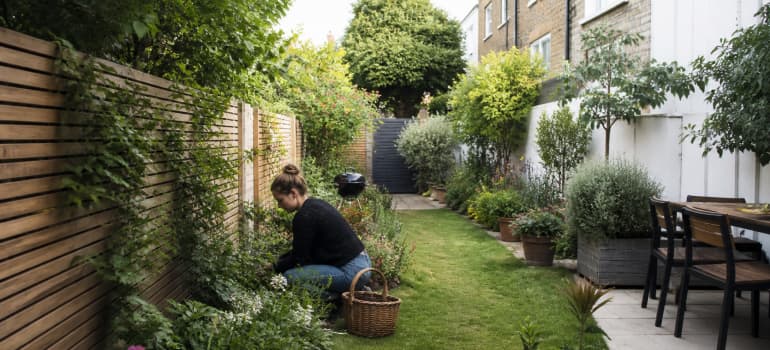
Long, narrow gardens can feel like a bit of a puzzle at first. You’re working with a shape that pulls the eye straight to the back fence, and without any thought to layout, it can end up feeling more like a corridor than an outdoor space you actually want to spend time in. The good news? That shape is far more workable than most people realise — and once you understand a few core principles, it starts to make sense.
If you’re trying to work out how to divide a long narrow garden, whether your plot is 6 metres wide or 3, whether it sits behind a Victorian terrace or a modern new-build, the approach is the same. This guide walks you through exactly what works — so it feels spacious, considered, and genuinely worth spending time in.
TL;DR
- Dividing a long narrow garden into zones makes it feel bigger, not smaller.
- Visual barriers like trellises and hedges add structure without boxing the space in.
- Curved pathways and asymmetrical planting break up that tunnel-like feel.
- Multi-functional features — think storage benches and vertical planters — save space while adding character.
- Common mistakes include over-planting, running paths straight down the centre, and ignoring where the sun falls.
- Layered planting creates depth and draws the eye across the garden rather than straight through it.
Table of Contents
How to Divide a Long Narrow Garden
The most effective way to divide a long narrow garden is to break it into distinct zones using visual barriers, changes in level, or planting — and to position these divisions across the width of the garden, not along its length. This stops the eye racing straight to the back fence and gives each section its own identity, making the whole space feel more generous and considered.
Think of it like rooms in a house. Each zone has a purpose, a feel, and a natural boundary. That boundary doesn’t have to be solid — in fact, it usually shouldn’t be. A partial screen, a low hedge, or a change in surface material can signal “you’re moving somewhere new” without cutting off light or making the garden feel cramped.
Zoning for Functionality
Zoning is probably the single most useful tool you have when designing a long narrow garden. The idea is simple: decide what you want your garden to do, then assign each activity its own dedicated space. It sounds obvious when you say it out loud, but most people fill the space without thinking in those terms and end up with a garden that does a lot of things passably and nothing particularly well.
A typical split might look something like this: a patio or seating area closest to the house where you can step straight out from the kitchen, a middle section for lawn or planting beds, and a further zone tucked away for a vegetable patch, a compost area, or a children’s play space. That last zone doesn’t need to look picture-perfect — and keeping it at the far end means the part of the garden you see every day stays tidy.
When it comes to sizing these zones, give each one enough room to actually function. A patio of at least 3x3m near the house is the minimum for a bistro table and two chairs to feel comfortable rather than squeezed. If you’re keeping a strip of lawn in the middle zone, aim for at least 1.5m of usable width — anything narrower and it becomes decorative rather than practical. The far zone can be more compact, especially if it’s purely utility: a compost bin and a couple of raised beds don’t need the same footprint as a seating area.
If you’ve got kids, a dedicated play area near the back makes sense. You can see them from the patio, but the slide and the mud kitchen don’t dominate your view. A vegetable patch at the far end gets the light it needs while keeping the main garden focused on relaxation or aesthetics.
The key with zoning is to make each area feel intentional. A bistro table and two chairs on a small gravel patch near the house immediately reads as “dining area,” even in a narrow space. A bench surrounded by soft planting says “sit here, slow down.” Small cues like these do a lot of the work.
Using Visual Barriers Effectively
Once you’ve decided on your zones, you’ll need something to mark the transitions between them. This is where visual barriers come in — and they’re worth getting right, because a clumsy partition can make a narrow garden feel genuinely suffocating.
Trellises are one of the most popular choices, and for good reason. A trellis panel with climbing plants growing through it acts as a semi-transparent screen. It gives you privacy and structure without blocking light entirely. Roses, clematis, or a vigorous annual climber will soften the structure quickly and make it feel like part of the garden rather than a fence bolted across the middle.
Pleached trees are another option if you want something more architectural. They create a “screen on stilts” effect — a clear trunk below and a flat canopy above — which keeps sight lines open at ground level while still dividing the space visually. They’re a bit of an investment, but they look incredibly smart in the right setting.
Low hedges work brilliantly for softer division. Box, lavender, or rosemary clipped into a low run can mark the edge of one zone without blocking anything above knee height. It’s a subtle cue rather than a wall, which is often exactly what a narrow garden needs.
Pergolas and overhead structures are worth serious consideration too. An arch or a simple pergola frame positioned across the width of the garden creates a natural “gateway” between zones without blocking light at all. Because the structure sits overhead rather than in front of you, it reads as a transition rather than an obstacle. Dress it with a climbing rose or wisteria and it becomes a genuine feature rather than just a divider. It’s one of the most effective tools for how to divide a long narrow garden without making either side feel cut off.
Whatever you choose, try to position your barriers diagonally or staggered rather than straight across the full width. That slight angle encourages you to move around the partition rather than through a gate in the middle, which keeps things feeling more natural and less like an obstacle course.
Long Narrow Garden Layout Ideas: What Actually Works?
So you’ve got the zoning principle down. Now, how do you actually lay the garden out so it doesn’t feel like a bowling alley? Here are four design approaches that genuinely make a difference in narrow spaces.
- Create curved pathways to break linearity. A straight path running from the back door to the end of the garden does one thing very efficiently: it shows you exactly how long the garden is. A gently curving path does the opposite. It slows you down, hides what’s around the bend, and breaks up that relentless forward pull. Even a slight curve makes a real difference. You don’t need a sweeping S-bend — just enough to interrupt the straight line.
- Stagger planting for depth. Rather than lining plants up in tidy rows along the borders, try planting in overlapping drifts that spill slightly into the garden from alternate sides. A bold clump of ornamental grasses on the left, then a tall perennial border jutting in from the right a metre further along — this kind of staggered arrangement creates depth and draws your eye across the space rather than through it. It also makes the borders feel more generous than they are.
- Use vertical planting for space efficiency. When you can’t go wide, go up. Vertical planting — whether that’s climbers on a fence, tall grasses and bamboo in a raised planter, or wall-mounted planters — adds drama and greenery without eating into your floor space. It also raises the eye level, which makes the garden feel more enclosed in a good way, more like a room. Espalier fruit trees trained against a fence and tall narrow conifers all earn their keep in a narrow plot.
- Lay decking or paving at 45 degrees to make the garden feel wider. This is one of the most effective tricks in a narrow garden and one that’s often overlooked. When boards or paving slabs run diagonally across the plot rather than parallel to the fences, the eye follows that diagonal line — which is the widest measurement available to it. It’s a simple material decision that does a lot of perceptual work, making a 3m-wide garden read as noticeably broader than it actually is.
How Do You Make a Narrow Garden Feel Wider?
This is the question most people are really asking when they think about how to divide a long narrow garden. Dividing it is part of the answer — but width is its own challenge.
The diagonal decking trick above is the single most effective hard landscaping move. Beyond that: keep the path off-centre, running closer to one fence than the other. This creates an asymmetry that reads as width. Use lighter colours and smaller-textured plants along the far fence to increase apparent depth. And avoid anything that runs continuously from one end to the other in a single straight line — that includes borders, paths, and edging strips.
What Are the Most Common Mistakes When Dividing a Narrow Garden?
The most common mistakes are over-planting both borders at once, running a path straight down the centre, and not checking where the sun falls before committing to a layout. Each of these undermines the design in a different way, but all of them are avoidable with a bit of thought upfront.
Over-planting is probably the most frequent one. It feels counterintuitive — surely more plants make a garden feel lusher and more interesting? But in a narrow space, dense planting along both borders simultaneously can turn a garden that was meant to feel cosy into one that feels genuinely claustrophobic. Leave some breathing room. A patch of lawn, a gravel section, or a simple paved area gives the eye somewhere to rest.
Poor pathway planning is another one. A path that runs straight and centred from one end to the other is the worst thing you can do to a narrow garden. It turns the space into a visual race track. Even moving the path off-centre so it runs closer to one border creates a more interesting dynamic, and gives you a wider bed on one side — which is useful for taller, more dramatic planting.
Ignoring the sun’s movement can really catch you out. In a long narrow garden, one side is often in shade for most of the day depending on which direction the plot faces. If you put your seating area in the wrong spot, you’ll find it’s never actually in the sun when you want to sit out. Spend time in the garden at different points during the day before you commit to a layout. It sounds obvious, but plenty of people skip it — then wonder why their beautiful patio gets about forty minutes of afternoon sun in summer.
Finally, don’t underestimate the impact of fence colour. Dark fences — navy, charcoal, dark green — recede visually and make planting pop. Bright or untreated timber fences draw the eye to them, which can make a narrow garden feel even more hemmed in. It’s a small decision, but it makes a noticeable difference.
Integrating Multi-functional Garden Features
In a narrow garden, every feature needs to pull double duty if possible. The more a single element can do, the less crowded the space feels — and the more genuinely useful your garden becomes day to day.
Seating with built-in storage is one of the most practical additions you can make. A timber bench with a lift-up seat gives you somewhere to sit and somewhere to stash cushions, garden tools, or kids’ outdoor toys — all in one footprint. It removes the need for a separate shed or storage box eating up floor space.
Raised beds along one border serve more than one purpose too. They define a zone, add height variation, and give you growing space for vegetables or herbs without a separate dedicated patch. Line one long border with a series of raised timber beds of varying heights and you’ve got structure, planting, and a visual feature all working together.
Movable partitions are worth considering if you want flexibility. Lightweight screen panels or large containerised plants on castors can be repositioned depending on the season or the occasion. In summer you might open the space up for a gathering. In autumn you might bring them together to create a sheltered seating nook. It’s not a common approach but it works well for gardens that need to serve multiple purposes across the year.
Working With Your Garden’s Aspect
Before you finalise any layout, work out which direction your garden faces — it changes everything about where you put things. A south-facing narrow garden gets sun along most of its length through the day, which gives you more flexibility. You could position a seating area at the far end, furthest from the house, where it often catches the most afternoon sun. A north-facing garden is a different calculation entirely. The far end can sit in shade for the majority of the day, so your seating area almost always belongs closer to the house, where the sun reaches first and longest.
East-facing gardens get morning sun and afternoon shade. If you want to sit out after work, the far end of an east-facing plot may be a poor choice for a patio regardless of how the rest of the design plays out. West-facing plots are the opposite — shaded in the morning, sunny in the afternoon and evening, which suits most people’s actual garden-use habits well.
Get this wrong and you can do everything else right — good zoning, solid planting, smart barriers — and still end up with a layout that doesn’t serve you the way you hoped. Spend a full day in the garden before you commit, or at minimum check a sun-tracking app for your postcode. It takes twenty minutes and saves a lot of regret.
Even lighting can be multi-functional in a narrow garden. Low-level path lights do a practical job while also drawing the eye along a curved route at night, emphasising the shape of the garden rather than its length. String lights strung across the width of the garden — fence to fence rather than along it — visually widen the space after dark. Small things, genuinely noticeable difference. If you’re planning a more significant overhaul, a professional garden design service takes care of the full planning and hard landscaping so your outdoor space gets the expert attention it deserves from the start.
Frequently Asked Questions
What is the best surface material to use for different zones in a narrow garden?
Mixing materials is one of the most effective ways to signal a zone change without a physical barrier. Decking near the house reads as a patio or dining area. Gravel or bark chippings work well for a planting or utility zone. A small area of lawn — at least 1.5m wide to be genuinely usable — can serve as a middle zone. The contrast between surfaces does the zoning work quietly, without the need for any additional structure.
How many zones should a long narrow garden be divided into?
Two or three zones is usually optimal. A typical split is: patio or seating near the house, a central planted or lawn area, and a utility or growing zone at the far end. More than three zones in a typical terraced-house garden under 15m long risks each section feeling too small to be functional. Keep it simple — a well-executed two-zone garden beats a cramped five-zone one every time.
Transform Your Narrow Garden With a Professional Design
Enter your postcode to view our rates and availability in your area.
For questions about the services we offer visit our main site
Conclusion
Knowing how to divide a long narrow garden is really about shifting your perspective. Instead of fighting the shape, you work with it — creating distinct zones, using planting and barriers to redirect the eye, and choosing features that earn their place. None of it has to be complicated or expensive. Often the most effective changes are the simplest ones: a curved path, a well-placed trellis, a raised bed along one border.
The goal is a garden that feels intentional and spacious, even if it’s neither in any strictly objective sense. Get the bones right and the rest follows. Check where the sun falls, don’t rush the layout decisions, and don’t try to do everything at once. A narrow garden that’s been thoughtfully divided is a genuinely lovely thing to spend time in.