
With the festive season swiftly approaching us, it is only natural we start planning our holiday decorations. A fresh Christmas tree is among the first things that come to anyone’s mind when we think of winter and the holidays. However, not everyone knows how to prune a Christmas tree to maintain a healthy appearance in a conifer.
Pruning for evergreens is just as important as it is for deciduous trees. If done the proper way, it can improve the appearance and health of your Christmas tree, maintain its compact size and traditional shape, control foliage and density.
As stressful as pruning may sound, you shouldn’t panic yet. Trimming a Christmas tree can be easy once you get the hang of it. For a smooth shearing, check our recommendations below on when and how to prune a Christmas tree.
TL;DR
- The best time to prune a Christmas tree is early spring or mid-summer (June–July).
- Avoid pruning in winter — open wounds are vulnerable to frost damage and infection during dormancy.
- To maintain the classic conical shape, keep the base width roughly two-thirds of the tree’s height.
- Never cut the top (leader) of the tree — conifers cannot regrow branches from bare cutting points.
- Remove broken, diseased, or dead branches first, then address any competing leaders.
- Pine trees require trimming of all terminal shoots on lateral branches; spruces and firs do not.
Table of Contents
What is the best time to prune a Christmas tree?
For most Christmas tree species — including Nordmann fir, Norway spruce, and pine — the best time to prune is early spring or mid-summer (June–July). Late summer and autumn also work well. Avoid pruning in winter to prevent frost damage and disease.
Evergreen trees, unlike deciduous trees, stay green all year round, although they still go through seasonal needle changes during which the plant sheds and renews its foliage.
The spruce, pine and fir tree varieties can be pruned at almost any time of the year. Generally, the best time to do the annual prune is early spring or during summer.
Alternatively, pruning in late summer and autumn also works well for evergreen trees. If you are looking to encourage the development of new buds specifically, we recommend shearing in mid-June or July.
Keep in mind that during the warmer months trees are more likely to be attacked by parasites, so it is important to know how to cut your Christmas tree’s branches in the safest way possible.
How to prune a Christmas tree
As already mentioned, pruning a Christmas tree is important, not only for the plant’s appearance and traditional shape but for its health, as well. However, cutting too extensively and rashly can leave behind open wounds which in turn will become an easy entrance for bacteria.
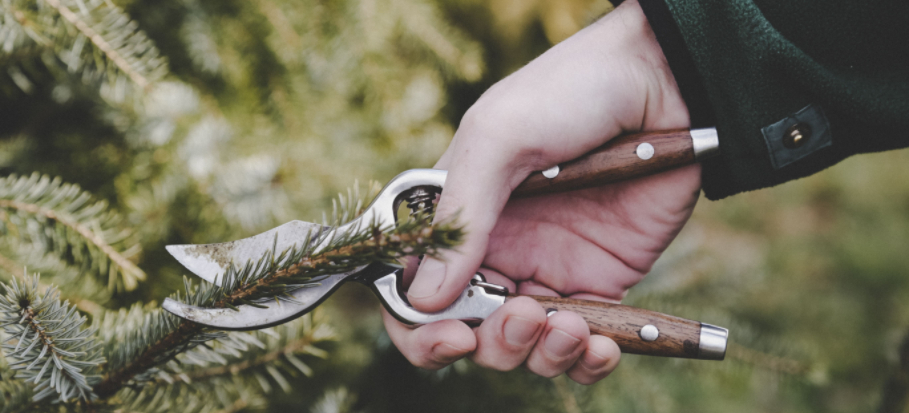
Use pruning shear or loppers to trim your Christmas tree without damaging its branches. You can also opt for an electric chainsaw. Moreover, always try to cut at an angle.
Conifers are fast-growing trees. The growing of Christmas trees in a pot is usually restrained by the size of the container, but if you are growing the tree in your garden, expect it to reach a great height. If you are wondering which branches of your tree should make the cut, consider the following:
How to prune a Christmas tree to maintain its traditional shape and keep it healthy.
Maintain the traditional shape
Cut back any protruding or badly positioned branches. It is recommended that the width of the tree’s base should be two thirds that of its height — this keeps the classic conical form intact.
Remove damaged or diseased branches
Make sure to remove any broken, dried up or diseased branches. There is no need for them to feed on the tree’s energy, and you wouldn’t want to risk disease transferring to the rest of the tree.
Manage competing leaders
If your tree has developed multiple leaders, choose the weakest of them and prune them back. If a leader is still in development, simply cut close to the branch collar. Otherwise, cut 2–3 cm above a good bud and remove all buds below this one to prevent the formation of future leaders.
Trim terminal shoots (pine trees only)
In the case of a pine tree, all terminal shoots on each lateral branch have to be trimmed to encourage bud development. That is not required with spruces and fir trees.
Will trimming a Christmas tree kill it?
Trimming a Christmas tree correctly will not kill it. Problems only arise when cuts are made in the wrong place, at the wrong time of year, or too severely — particularly if the leader (top) is removed, which conifers cannot recover from.
However, if you keep in mind several things while shearing and shaping your Christmas tree, you can decrease the chance of disease infection. Here are some things to be careful about when pruning your evergreen tree:
- Specialists recommend avoiding cutting the top of the tree or shortening the main branches as conifers don’t regrow branches from cutting points.
- Don’t clip into the collar or the parent branch. That is where the natural defences of the tree are located. If you cut into the collar or closer to the trunk, you will damage the tissues capable of closing cutting wounds.
- Moreover, cutting at a 45-degree angle is important so that water doesn’t collect on the cut surface and promotes the development of diseases.
Frequently Asked Questions
Can I prune a Christmas tree in winter?
It is best to avoid pruning Christmas trees in winter. During dormancy, pruning leaves open wounds that are vulnerable to frost damage and disease. Wait until early spring or, at the latest, mid-summer (June–July) before shearing or shaping your tree.
Will a Christmas tree regrow branches after pruning?
No — conifers do not regrow branches from bare wood. Once a branch is cut back beyond its green growth, it will not regenerate from that cutting point. This is why specialists recommend never removing the leader (top) or shortening main branches significantly: the resulting gap will be permanent.
Does pruning seem like too much work? Book a service!
Following the advice of professional gardeners can make pruning a Christmas tree easy and safe. Still, this process can be time-consuming and rather difficult if you don’t have the necessary tools.
In case you don’t have the time or the skills to handle the annual Christmas tree trimming on your own, don’t worry as this is totally fine. Consider contacting a qualified tree surgeon.
Professionals like tree surgeons use specialised equipment, can deal with even the highest trees and know how to trim a Christmas tree back to its healthy appearance. Book a pruning service today and let Fantastic Gardeners do the job for you.
You don’t have a Christmas tree for this year’s holiday? No worries, Fantastic Gardeners has your back! Book a Christmas tree delivery today and enjoy an authentic Christmas atmosphere.
Need help pruning your trees?
Enter your postcode to view our rates and availability in your area.
For questions about the services we offer visit our main site
***
Let us know what you think about this article in the comments section below. We would love to hear from you!
Image source: Shutterstock / triocean


Our planted Christmas tree is getting too tall. Am I correct in not pruning the leader? Will it restrict growth if we repot it. If so, what size pot, in relation to it’s height?
Thanks
Great article! I like that it talks about how to properly prune a Christmas tree and tree pruning is important for the health of the tree itself. Nice read and tons of value.